Ralph Anderson . Felix Baudenbacher . Olivia Bax . Dominic Beattie . Will Cruickshank . Tim Ellis . Olly Fathers . James Alec Hardy . Stephen Jaques . Tess Jaray . Caroline Kryzecki . Steve Lewis . Kate Matthews . Mali Morris . Selma Parlour . Charley Peters . Alice Wilson.
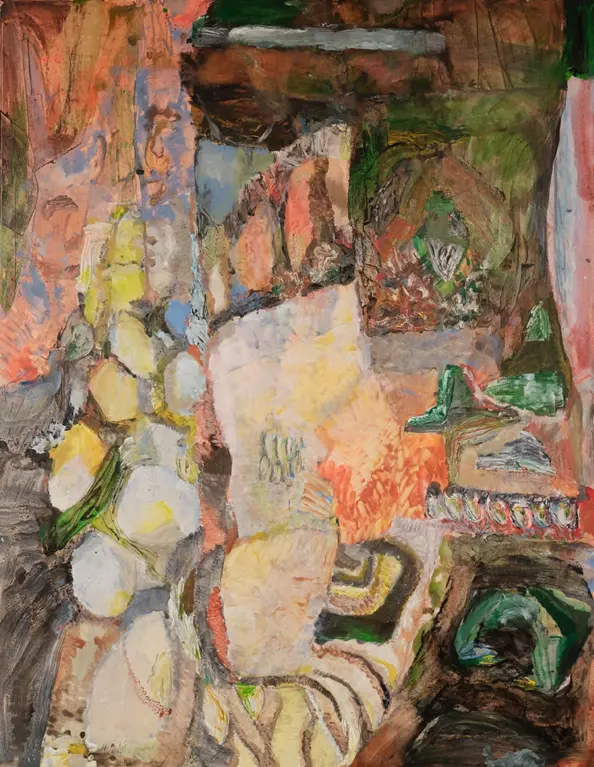
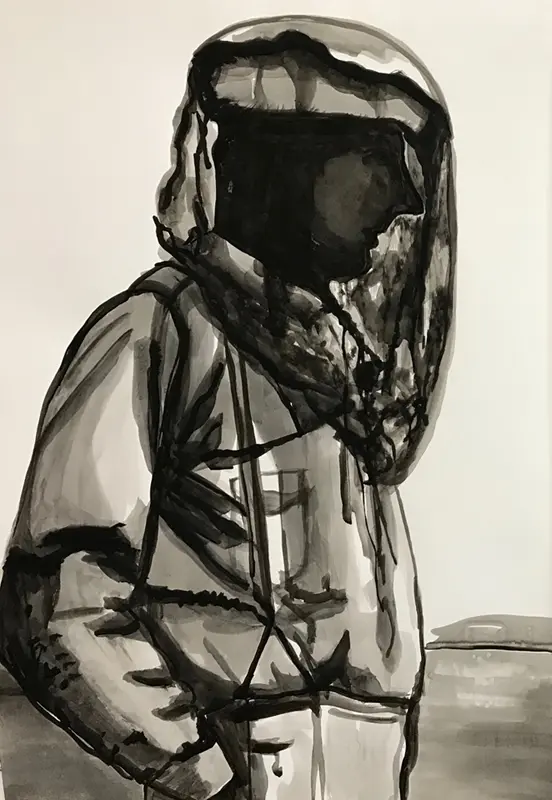
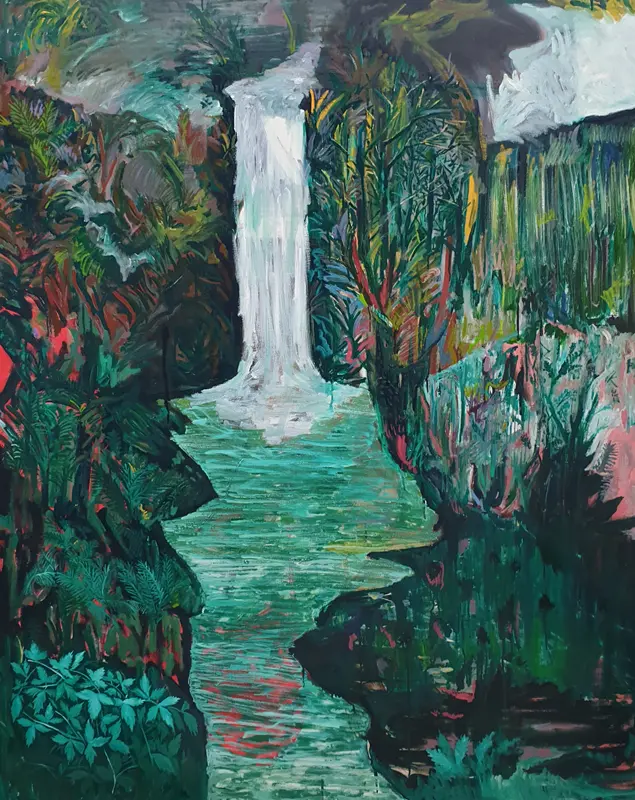
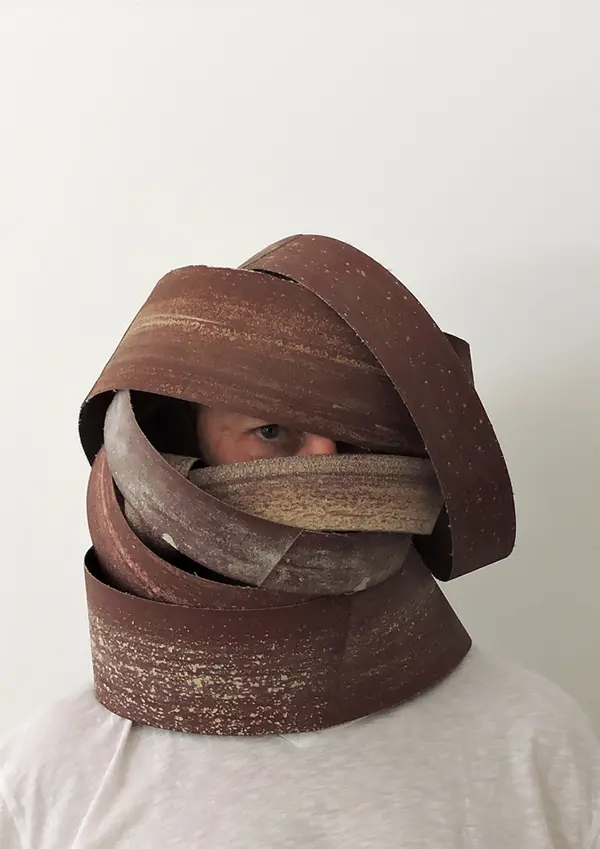
Harder Edge is a survey of recent abstraction curated by Dominic Beattie and Ali Hillman. The selection of 17 artists examines a breadth of visual languages from an international and multi-generational line up. The exhibition moves through an exploration of abstraction, challenging and testing the abilities of a large variety of materials in the artists’ individual interrogations of colour, line and form.
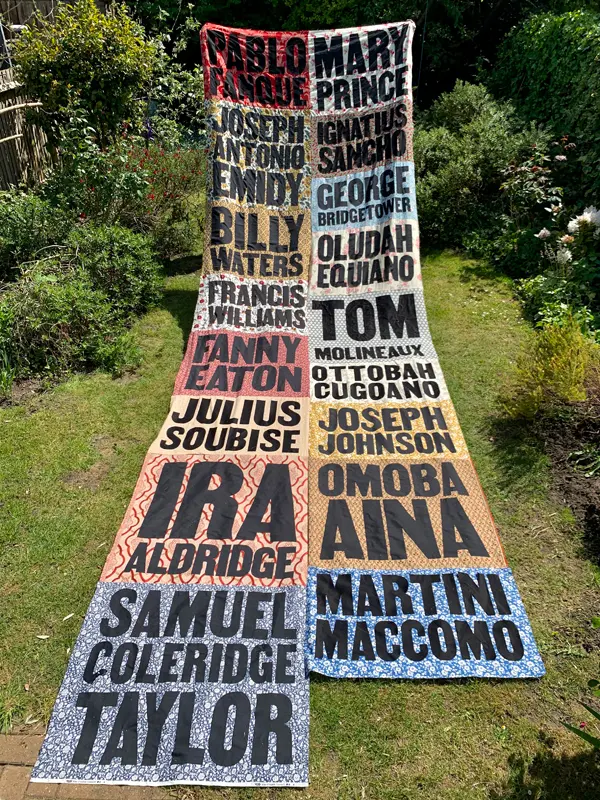
‘Aleppo From the Dark’ by Tess Jaray flanks the entrance to one gallery, in a clean editing of form and colour. The six panel painting feels formal and considered in a journey that moves through exquisitely controlled drips (Olly Fathers and Ralph Anderson), welded steel (Steve Lewis), enormous papier mache sculpture (Olivia Bax), tufted totems (Will Cruickshank), cast object d’arte (Tim Ellis), multi-screen installation (James Alec Hardy), Block Printing on a large scale (Dominic Beattie) and a painting made with construction timbers (Alice Wilson).
Figurative art from the Khartoum School
SALON, in collaboration with Roubi L’Roubi, is delighted to present Forests and Spirits: Figurative art from the Khartoum School, an exhibition of recent works by Sudanese artists Salah Elmur, Kamala Ishaq and Ibrahim El-Salahi.
Opening on 28 September, the show is comprised of 14 medium and large-scale paintings – 9 by Elmur and 5 by Ishaq – and a single sculpture, Meditation Tree (2018), by El-Salahi*.
Conceived by Roubi L’Roubi, curator of the Foundation Gallery, and Philippa Adams, Saatchi Gallery’s Director, Forests and Spirits seeks to bring wider attention to contemporary African art, and in particular the enduring influence of the Khartoum School. Formed in the 1960s, the Khartoum School was an art movement centred around the city’s College of Fine and Applied Arts, the institution which has itself been pivotal in the development of contemporary art in Africa. Ishaq and El-Salahi, are among its founders, while Elmur was a pupil in the 1980s when Ishaq, a former graduate, was head of painting.
In this landmark presentation, Ishaq and Elmur’s paintings will be displayed around El-Salahi’s Meditation Tree. His first sculpture, the work fulfils the artist’s long-held ambition to render his drawn images in three dimensions and to play with their scale. The work, part of his ‘Tree’ series, was inspired by the characteristics of a peculiar type of acacia tree called Haraz. Indigenous to Sudan, the Haraz is of great cultural, spiritual and economical significance – the country’s largest export, gum Arabic, is harvested from it – and forms part of the artist’s ongoing investigation of the tree/body metaphor, a link between heaven and earth, creator and created.
Trees are a recurring trope in Elmur’s work. Many of the paintings featured in this show are drawn from his celebrated ‘Forest’ series, first seen in his acclaimed 2018 retrospective at the Sharjah Art Museum, UAE. These were inspired by the Sunut Forest, which lies on the junction of the White Nile and Blue Nile at the centre of Khartoum. It is a place where people come to celebrate and picnic. The Bride and Queue of Admirers (2017) captures one such occasion. Four besuited male figures stand around a female in a white dress. Behind them are six green-barked trees. The man on the right, presumably the groom, appears pleased and complaisant, while the others peer enviously at his prize. As with many of his paintings, it exudes intrigue and mystery, asking questions but providing no answers.
Ishaq, meanwhile, has long been preoccupied with the cult of Zar, the term for a demon or spirit assumed to possess individuals, mostly women. The ceremony to drive them away is not an exorcism as perceived by Western sensibilities, it typically includes music and dancing and is effectively an exercise in social restraint, as the ‘demon’ is often nothing more than an undesirable personality trait such as rudeness or licentiousness.
In Preparation of Incense (2015), Ishaq summons her vision of Zar. Thirteen female figures appear as spirits apparently ascending into the heavens. Various swirling plants convey the sense of movement; these dart left and right like shoals of fish, but also grow from the subjects’ mouths, which are agape – possibly wailing, revealing rows of harrowing, broken teeth.
In contrast, Elmur’s paintings are models of constraint. His subjects sit or stand motionless like they are presenting themselves to a camera for an official portrait. This echoes his father and grandfather’s association with photography. For many years they ran a studio in Khartoum and while it closed before he was born, the artist was fascinated by the portraits that were arranged around his family home.
Elmur’s work chronicles the quotidian, capturing the people of Khartoum at play, in domestic settings and at work. His paintings present no discernible narrative. His subjects might hold a plant in their hand, or a musical instrument, an animal or a child, but if they symbolise anything the viewer is left to develop their own thoughts.
Says curator L’Roubi: ‘At a time of great interest in African art, it is a special privilege to bring these three unique talents together, and in particular to place the spotlight on Kamala Ishaq, one of three founders of the Khartoum School and a seminal figure in the development of modern and contemporary African art.
‘Like El-Salahi, both Ishaq and Elmur draw on older traditions for inspiration – Ishaq with the ceremony of Zar and Elmur, in the works presented here, on the delicate interplay between nature and humanity, the spiritual and the temporal, a line of investigation that unites the practices of all three artists.’
Says Philippa Adams, Director, Saatchi Gallery: ‘We are delighted to be showing works by these three distinguished artists of the Khartoum School, in an exhibition that reveals the unique contribution each has made to the development of African art.’
* Ibrahim El-Salahi’s Meditation Tree (2018) appears courtesy of Vigo Gallery, London.
About Salah Elmur
Salah Elmur (b. 1966) is a graduate of the College of Fine and Applied Art, Khartoum. An acclaimed painter, illustrator, photographer and filmmaker, his artworks have been displayed across Africa, the Middle East, Europe and North America. Over the course of his career, he has composed and illustrated more than 35 children’s books that have been published in Arabic, French, Italian and Spanish. His skills as an illustrator have won him several international awards including an accolade from the Sharjah Children’s Reading Festival. As a filmmaker, Elmur has directed and produced six short films, including documentaries and fantasy films, which have been screened at a number of international festivals. He won the Jury Prize (special acknowledgement) for his film Heaven’s Bird at the International Short Film Festival in Ethiopia in 2010. In 2018, he was the subject of major retrospective at the Sharjah Art Museum, UAE. Hiis work is in many private and public collections, including The Museum of African Contemporary Art Al Maaden (MACAAL), The Sharjah Art Museum and the Sharjah Art Foundation (SAF).
About Kamala Ishaq
Kamala Ishaq (b. 1939) graduated from the College of Fine Art, Khartoum (1963) and pursued postgraduate studies at the Royal College of Fine Art, London (1964-1966). She was later employed by the College of Fine Art, Khartoum as a lecturer and then head of the painting department. Exhibitions include: Kamala Ibrahim Ishaq: Women in Crystal Cubes (2016-17); Shibrain Art Centre, Khartoum (2014); Breaking the Veils: Women Artists from the Islamic World, sponsored by the Royal Society of Fine Arts, Jordan (2002); Sharjah Art Museum, UAE (1995); Whitechapel Gallery, London (1995); National Museum of Women in Art, Washington, DC (1994); Camden Art Centre, London (1970), among others.
About Ibrahim El-Salahi
Ibrahim El-Salahi (b. 1930) lives and works in Oxford, England. El-Salahi’s career spans over five decades and is marked by rigorous experimentation within a Modernist vocabulary. Like other African artists of his generation, he sought to create a national art and aesthetic, born out of the effects of colonialism and steeped in the history and culture of his country. After returning to Sudan in 1957, following his study at the Slade School of Art in London, he developed a painting language that synthesised various hybrid forms. In addition to exploring the symbolic and formal potential of traditional Arabic calligraphy, he incorporated the Africanised arabesque script used by his father for transcribing verses of the Qu’ran, as well as the traditional crafts and ornamentation found in his homeland. El-Salahi’s art also reflects his itinerant life, and his many travels outside Sudan. The murals of the Mexican social-realists, the abstract geometric paintings of Piet Mondrian, and the cut-outs of Matisse are some of the influences that shape his work. Although his work has changed stylistically over the decades, it remains consistent in the artist’s reliance on line drawing as an overarching structural and emotive device. His insistence on an art form that is socially, politically and spiritually engaged in the world is also a critical component of his work. He is also widely regarded for his numerous critical essays and is the recipient of dozens of honors and fellowships. He has received solo exhibitions of his work at the Tate Modern and ICA in London, Sharjah Art Museum, and numerous galleries around the world. His work is included in the permanent collections of the Museum of Modern Art, New York, Metropolitan Museum, New York, The Art Institute of Chicago, Chicago, The British Museum, London, Tate Modern, London, The Smithsonian Institute, Washington DC, The Guggenheim Museum, Abu Dhabi, The National Gallery, Berlin, and many others. He was the subject of a major exhibition at the Ashmolean Museum, Oxford, A Sudanese Artist in Oxford, in 2018.
About the Khartoum School
The Khartoum School was a Modernist art movement formed in Sudan in the 1960s that sought to develop a new visual vocabulary to reflect the distinctive identity of the newly independent nation. Ahmed Shibrain and Kamala Ishaq were among its As one of the most active contributors to the growth of modern art in Africa, the group was typified by its use of primitive and Islamic imagery. One of its distinctive characteristics was the use of calligraphic writing, in which the artists would simplify Arabic script into abstract shapes. This aesthetic, called hurufiyya, together with Islamic motifs, became a hallmark of the Khartoum School. Ibrahim El-Salahi and Kamala Ishaq were among its founders.
About the Foundation Gallery
The Foundation Gallery, based in London, was founded was founded by Roubi L’Roubi to provide a platform for communication, creative management for artists and the production of supporting exhibitions.
|
About Roubi L’Roubi
L’ Roubi is a London-based creative director with a keen interest in contemporary art, and in particular African art. He is a graduate of Imperial College, London, where he studied mechanical engineering. On graduating, he worked in the fashion manufacturing industry. Recently, he has returned to engineering, and his current work unites these two disciplines, using technology and design, fused with nature, to advance bio-medical innovation.
About SALON at Saatchi Gallery
SALON is a project space at Saatchi Gallery that has been created to present the work of leading international artists who have had limited exposure in the UK. Located in its own self-contained space at the Saatchi Gallery, this venture collaborates with galleries and artists’ estates in selling exhibitions, and is directed by Philippa Adams, Senior Director, Saatchi Gallery.
|
Presented and curated by Eva McGaw and Tatiana Palinkasev
In recent years, Rashid has experimented with metal surfaces, creating openings in his aluminium wall works and revealing the intimate space behind the surface, usually kept out of view. Penumbra takes this approach a step further, exploring changes in spatial experience depending on the viewer’s position.
Upon entering the first exhibition space, the audience encounters convex wall works adorned with colourful flaps that suggest a feeling of movement. Rashid refers to the wall-mounted aluminium pieces, whose intricate patterns are based on complex mathematical geometric design, as ‘parametric sculptures.’ In the centre of the room, three-tiered columns wreathed with geometric flaps are suspended from the ceiling, drawing the viewer closer. There is tension created between the vibrant and ornate steel grids and the calmness of the voids within, just out of reach of the viewer in a realm of semi-privacy.
In the second exhibition space, the viewer is confronted with a colourful maze, a colossal grid structure that reimagines the shapes and tones of an urban environment, and explores architecture, city planning and memories. Rashid comments: ‘I was inspired by winding narrow alleyways and traditional architecture. I would like the audience to experience the maze as a conceptual entity – a spiritual journey with no fixed destination.'”
Rashid Khalifa, Site-specific grid maze from the series Penumbra, 2018.
Enamel on steel bars. W 400 x L 1193 x H 230cm.
Photography by whodoeswhat.tv
About Rashid Khalifa
Rashid Khalifa (b. 1952) began painting at the age of 16 and had his first exhibition at the Dilmun Hotel, Bahrain in 1970. He travelled to the UK in 1972 where he attended the Brighton and Hastings Art College in Sussex and trained in Arts and Design.
Rashid’s artistic practice has evolved over time: from landscapes in the 70s and early 80s, to merging elements of his figurative and abstract work in the late 80s, progression towards abstraction and experimenting with the ‘canvas’ in the 90s, and recent mirror-like chrome and high gloss lacquer pieces
His solo exhibitions include Hybrids, Ayyam Gallery, Dubai, UAE (2018); Convex: A New Perspective, Bahrain National Museum, Kingdom of Bahrain (2010); Art Department, Shuman Arts Organisation, Jordan (1997); De Caliet Gallery, Milan, Italy and El Kato Kayyel Gallery, Milan, Italy (1996).
Biennials include: Bridges, Grenada Pavilion, 57th Venice Biennale, Venice, Italy (2017); 3rd Mediterranean Biennale: OUT OF PLACE – Sakhnin Valley, Israel (2017); Arab Delegation, TRIO Biennial – Rio de Janeiro, Brazil (2015); and In The Eye of the Thunderstorm, Collateral Events, 56. la Biennale di Venezia – Venice, Italy (2015).
Rashid has also taken part in various group shows, international art fairs, and exhibitions alongside the Bahrain Arts Society.
About Eva McGaw and Tatiana Palinkasev
Eva is an entrepreneur with a special focus on business development and has been actively involved in the world of arts since the early 1990’s. She pursued her passion by supporting Eastern European artists and by commissioning and producing exhibitions. She has lived in the Middle East for over 17 years where she was appointed special representative for Sotheby’s.
Tatiana began her career at Christie’s Auction House in London and worked in their Madrid and Rome offices where she gained her understanding and experience of the international art market, private and public collections and auction house business. After valuable experience at Christie’s internationally, Tatiana co-founded Callisto Fine Arts Consultancy focusing on private clients, curatorship and exhibitions.
Eva and Tatiana together established “Metamorphosis Art Projects” where they produce and curate art exhibitions with a special edge. They create extraordinary experiences to motivate artists in developing new forms of expression, helping them to communicate their innermost beliefs and convictions and to inspire their audience. Interaction and inspiration is the key element in their exhibitions.
Presented by Mark Sanders Art Consultancy
The School of Night will feature exceptional new works by Wolfe von Lenkiewicz, with the highlight being a vast four by ten metre canvas based on Rembrandt’s The Night Watch.
The title of the main painting, and the series as a whole, refers to a quote from Shakespeare, “Black is the badge of hell, the hue of dungeons and the school of night”. The School of Night alludes to a secret society of alchemists centred on Sir Walter Raleigh, Thomas Harriot and Christopher Marlowe, who became key players in the secret alchemical history of England.
Other works in the exhibition include, Christ on the Cross, a haunting crucifixion painted in a subtle palette of ivory andThe Anatomy Lesson of Doctor Tulp . A notable painting on display will also be Azazel, which refers to a fallen angel. This is a powerful yet unmistakably unnerving piece is based on Rembrandt’s 1640 self-portrait.
The organic forms in Lenkiewicz’s latest series of paintings feature new elements including gold, crystals and glass. With their Jewel-like hues, refracted colour and iridescent light, these semihallucinatory works create a relationship between surface and interiority which both embellish and obfuscate the originals. In essence, they present an alchemical reaction between the real and the imagined, intersecting the genres of history and the natural world to create a body of work that is both visually arresting and highly original. Embedded in these paintings are oriental ivory carvings, gelatinous forms and deep-sea creatures that when fused with the original masterpieces produce a new and miraculous reincarnation of the originals. As Jules Verne once described Captain Nemo’s submarine, The School of Night series can also be described as ‘a masterpiece containing masterpieces.’
Lenkiewicz’s practice actively engages with the art of the past to invigorate and rejuvenate one’s understanding of what it means to be a painter today. Fellow practitioners working in this key strand of contemporary art, including Glenn Brown and John Currin, represent an established trend that has been developing over the past two decades. This movement subverts the postmodernist myth that we are all caught in a ‘perpetual present’, revealing instead that the art of the past is a living entity that continues to influence our understanding of painting today.
ABOUT WOLFE VON LENKIEWICZ
Wolfe von Lenkiewicz (b. 1966) is based in London. He graduated from the University of York with a degree in Philosophy, specialising in Contemporary Epistemology, which has influenced and guided the conceptual side of his art practice since. Lenkiewicz’s chief artistic concern is our use of language and its re-interpretation in visual culture. He is known for his reconfigurations of iconic images from both art history and our broader visual culture. Through a series of often controversial interventions, his compositions raise radical questions about authenticity and authorship within the arena of contemporary art.
Lenkiewicz has exhibited at the Palais des Beaux Arts de Lille, the ME Collectors Room in Berlin, La Maison Rouge in Paris, the Deichtorhallen Museum in Hamburg and the Wexner Center of the Arts in Ohio. This year he completed his first solo museum show entitled The Processions of Orpheus at the Jewish Museum and Tolerance Centre in Moscow with a body of work focused on Picasso. His work is featured in numerous public and private international collections.
ABOUT MARK SANDERS ART CONSULTANCY
Mark Sanders Art Consultancy Ltd was formed in 2008 by the curator and art writer Mark Sanders. Formerly Director of All Visual Arts in London and acting Director for RS&A Ltd, he has staged a number of important international travelling shows including The Art of Chess (featuring new sculptural commissions by Damien Hirst, Tracey Emin, Paul McCarthy, Yayoi Kusama and Maurizio Cattelan) as well as critically acclaimed group shows in London.

Ninety Selected Oils, Works On Paper And Prints By Berenice Sydney
Berenice Sydney was born in Esher, Surrey, and studied at the Central School of Art, London. However, she did not complete her studies here as she felt the course was too vocation-focused and on leaving she set up her studio in Chelsea where she experimented with figurative painting and printmaking techniques. Her first show was held in 1968 at Drian Galleries, in the Arts Review the art critic Marina Vaizey praised her drawings based on Greek myths as ‘neo-classical in technique and vaguely reminiscent of the famous period of Picasso’.
Throughout the 1970s Berenice pursued print-making, including screenprints, lithographs, monoprints, serigraphs and etchings on a variety of materials. The installation of an old press in her north London home facilitated these endeavours which she felt stemmed from her ‘literary side’.
She soon realised that figures were not necessarily required as a starting point because colour could provide everything she required, and from that point on she was enthralled with the exploration of colour combined with perpetual movement. When working on canvas Berenice limited herself to a palette of six colours, describing it as her ‘magic number’. She became absorbed with the properties of colour and ascribed a personality to each, commenting on their respective traits she said: ‘some colours are nasty, some friendly and some have little character’.
The daring colour combinations, as seen most strikingly in her oils, imbued these paintings with movement and drama. She started the painting at the centre of the canvas, building a journey of ‘contained colour’ in every direction and radiating outwards.
For Berenice, painting and drawing were quite separate, ‘I concentrate on either one or the other – colour or line’, she said. In her works on paper there is a clear link between the written word and the drawn line, but, Berenice would cringe when asked to explain what she produced, exclaiming ‘how can one verbalise visuals?’. In March 1983, towards the end of her life, she attempted to evaluate her late paintings. At this stage, after many exhibitions and praise from critics and curators, she had no need to be reticent about her achievement, ‘…when I feel I could eat bits of one of my paintings, I know these bits are beautiful…I concede therefore that my paintings leave one speechless…’.
Saatchi Gallery is pleased to present KNOWN UNKNOWNS, a major new exhibition featuring the work of 17 contemporary artists.
Known Unknowns showcases an international selection of artists, born between 1966 and 1990, from the Saatchi Gallery’s collection. The title refers to the artists’ status in the mainstream art world – whilst the group is largely unknown, their respective practices are greatly admired by their artistic peers and seen as breaking new ground.
The exhibition features a diverse range of art forms including painting, sculpture, video and mixed media, with a particular focus on the craft of art-making. The works deal with a myriad of themes that relate to the visual conditions of contemporary life, such as the exponential flow of images, the representation of the body in the Internet age, and the ethics of viewing versus voyeurism.
These artists are not afraid to explore new media in thought-provoking ways, and each pursues a highly individualised practice. They are a seemingly disparate group, yet together reflect the diversity and breadth of contemporary art in a globalised and increasingly digital age.
While Known Unknowns does not offer an obvious unifying theme or ideological point of view, it presents its audience with a group of artists that are worthy of wider exposure.
Tom Anholt |Sara Barker | Alida Cervantes |Francesca DiMattio |Theo Ellison | Maria Farrar | Stefanie Heinze | Chris Hood | Rannva Kunoy | Jill McKnight | Stuart Middleton | Mona Osman |
Kirstine Roepstorff |
Ben Schumacher |
Tamuna Sirbiladze |
Isobel Smith |
Bedwyr Williams |
Saskia Olde Wolbers|
Oneness Wholeness draws on thousands of years of Iranian culture, weaving ancient Persian motifs, patterns and landscapes into large-scale mixed media paintings, to explore Iranian identity in the 21st century. Descended from the ancient nomadic Bakhtiari tribe, Sassan’s large scale paintings recall the Zagros Mountains in South West Iran that are still home to the tribe, amongst other subjects. The Oneness Wholeness series features new, previously unseen work that Sassan has been developing for the last few years.
Through exploring his Persian heritage and his dedicated meditative practices, Sassan has used his art as cathartic release, leading him to explore ideas around existentialism, human compassion and wellbeing.
Oneness Wholeness will be Sassan Behnam-Bakhtiar’s first UK exhibition since The Real Me, his debut in London in 2014.
About Sassan Behnam-Bakhtiar
Sassan is also committed to supporting other emerging artistic talent from Iran and showcasing the rich cultural legacy of one of the world’s oldest cultures. In 2015 he set up the Fondation Behnam-Bakhtiar in Saint-Jean-Cap-Ferrat, where he provides emerging, mid-career and established Iranian artists a platform to showcase their work to the international art market.
Currently based in Saint-Jean-Cap-Ferrat, Sassan was born during the middle of the Iran-Iraq war in the Parisian suburb of Neuilly-sur-Seine in 1984. Sassan lived in Paris for most of his childhood, spending much of his spare time visiting the city’s many art galleries, before moving to Tehran at the age of ten. Sassan began making work in 2009 and has since exhibited internationally. He lives with his wife in Saint-Jean-Cap- Ferrat, Cote d’Azur, where they have set up an art gallery in the neighbouring principality of Monaco, in Monte-Carlo, that exhibits Iranian artists alongside established international artists.
https://www.sassanbehnambakhtiar.com/
About Nina Moaddel
Nina Moaddel is an Iranian born curator and advisor based in London. She has curated exhibitions in Europe and Asia with a focus on Iranian artists, including the Tehran Pavilion at the 9th Shanghai Biennale. Her advisory work relates to placing Iranian and Western artworks in reputable private collections as well as foundations and museums internationally including Museum of Everything, Musée d’Art Classique de Mougins and a/political foundation. She has also collaborated with institutions worldwide including Kunsthal Rotterdam, Tehran Museum of Contemporary Art, Institute of Contemporary Arts London, Royal Academy of Arts and Saatchi Gallery.
<"[By 1960], I decided I didn't want to express other artists' ideas any longer. I wanted to paint what was in front of me." Philip Pearlstein, Studio International, 2016
SALON, in collaboration with Betty Cuningham Gallery, New York, is delighted to announce its fourth exhibition, Paintings 1990 – 2017, a presentation of works by the revered American artist, Philip Pearlstein.
Pearlstein, now 93, has had an active career in the US and abroad since the mid-1950s. He first studied painting at the Carnegie Institute of Technology where he met Andy Warhol. Upon graduation, Warhol and Pearlstein moved to New York together to seek work in commercial design and pursue their own fine art careers. Pearlstein worked in an abstract expressionist style in the 1950s, before shifting to realism. This show, which is comprised of eight large-scale works in oil, is a celebration of his depiction of the human nude, a subject that has preoccupied Pearlstein since 1960 – as he says, ‘it is a shape that is always changing.’ In the 1980s, Pearlstein began to surround his sitter with objects from his personal collection to further engage the viewer and challenge himself. This exhibition highlights the strategies he employs in creating a complexity in his paintings that continues today.
Models and Blimp (1991), with its Michelin man, decoy swan and antique weathervane, is illustrative of Pearlstein’s mature work. While the props around the two female models intrigue, they are not there to create meaning or narrative. For Pearlstein, painting is abstract, it is just painting: his approach to living, human flesh is the same as to inanimate objects.
In this work, as with others, Pearlstein chooses a point of view that creates the most challenging composition for him to paint, and for the beholder to view. The unsettling effect of the skewed, oblique angles and perspectival compression is further reinforced by the truncation of the head and legs of the model in the foreground.
Masterful and powerful, every painting featured in the show goes against the conventions of portraiture – often emotive and introspective. Pearlstein’s works maintain a sense of complete detachment, which is both alluring and disconcerting.
Says Senior Director Saatchi Gallery, Philippa Adams: ‘Philip Pearlstein’s approach to the nude is unflinching – as a realist, he paints what he sees. However, the introduction of random objects from his studio brings a sense of ambiguity. Indisputably one of America’s greatest artists, SALON is honoured to be working with Pearlstein, and with Betty Cuningham, to bring this exhibition together.’
About the Artist
Philip Pearlstein was born in Pittsburgh, PA in 1924. He received a BFA from Carnegie Institute of Technology in 1949 and an MA from NYU’s Institute of Fine Arts in 1955. That same year he had his first solo show at Tanager Gallery. Among Pearlstein’s honours are a National Endowment for the Arts grant, 1968; a Guggenheim Foundation fellowship, 1969; and election to the American Academy and Institute of Arts and Letters, 1982, for which he served as President from 2003 – 2006; and recently the Icon Award in the Arts from the Bruce Museum in Greenwich, CT. Honorary Doctorates received from: Carnegie Mellon University, Pittsburgh, 1983; Brooklyn College, Brooklyn; College of Art & Design, Detroit; New York Academy of Arts, New York; and Lyme Academy College of Fine Arts, Old Lyme. Currently, he lives and works in New York City.
Pearlstein’s work can be seen in a host of prestigious collections in the United States, most notably: The Art Institute of Chicago, Chicago; Carnegie Museum of Art, Pittsburgh; The Cleveland Museum of Art, Cleveland; de Young Museum, San Francisco; Hirshhorn Museum, Washington DC; Metropolitan Museum of Art, New York; Morgan Library and Museum, New York; Museum of Fine Arts, Boston; Museum of Fine Arts, Houston; The Museum of Modern Art, New York; National Gallery of Art, Washington DC; Philadelphia Museum of Art, Philadelphia; Portland Museum of Art, Portland; and the Whitney Museum of American Art, New York.
About Betty Cuningham Gallery
Betty Cuningham has by her own admission reinvented her gallery several times. In 1972, she opened her first gallery on Prince Street in the heart of Soho, just above the well-known bar, Fanelli’s, where she showed John Walker, Ross Bleckner, Ray Parker, David Diao among others. In 1982, Mike Fanelli died and Betty moved uptown to join Hirschl & Adler Modern where she first began working with Philip Pearlstein. This was the beginning of their 36-year business partnership. The pair moved twice: in 1998 to the Robert Miller Gallery and in 2004 to her re-opened Betty Cuningham Gallery. Currently she represents (in addition to Philip Pearlstein) Rackstraw Downes, William Bailey, the Estates of Christopher Wilmarth, Andrew Forge, and Jake Berthot and Bill Traylor from the Charles E. and Eugenia C. Shannon Trust. After 10 years in Chelsea, the gallery relocated to Manhattan’s Lower East Side (only a few blocks away from where she first opened).
[email protected] | www.bettycuninghamgallery.com
About SALON at Saatchi Gallery
SALON, Saatchi Gallery’s new project space has been created to present the work of leading international artists who have had limited exposure in the UK. Located in its own self-contained space at the Saatchi Gallery, this new venture will collaborate with galleries and artists’ estates in selling exhibitions, and is directed by Philippa Adams, Senior Director, Saatchi Gallery.