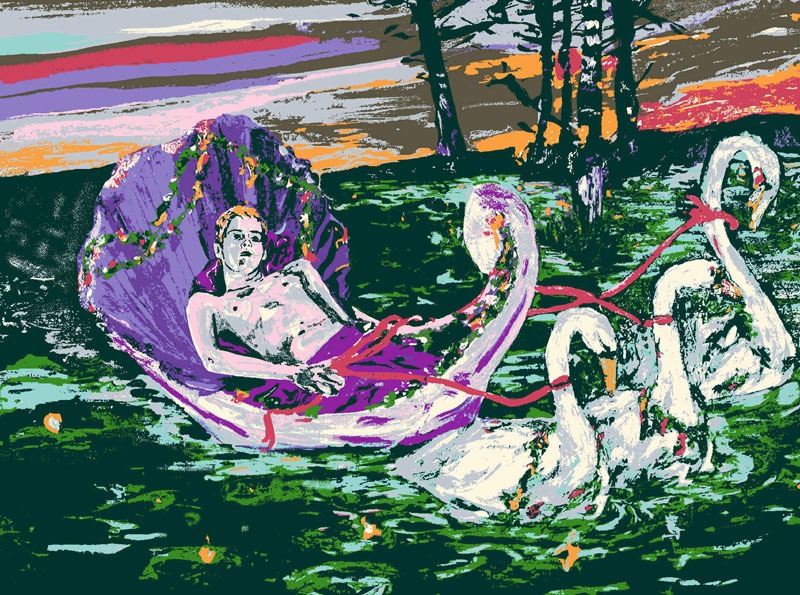
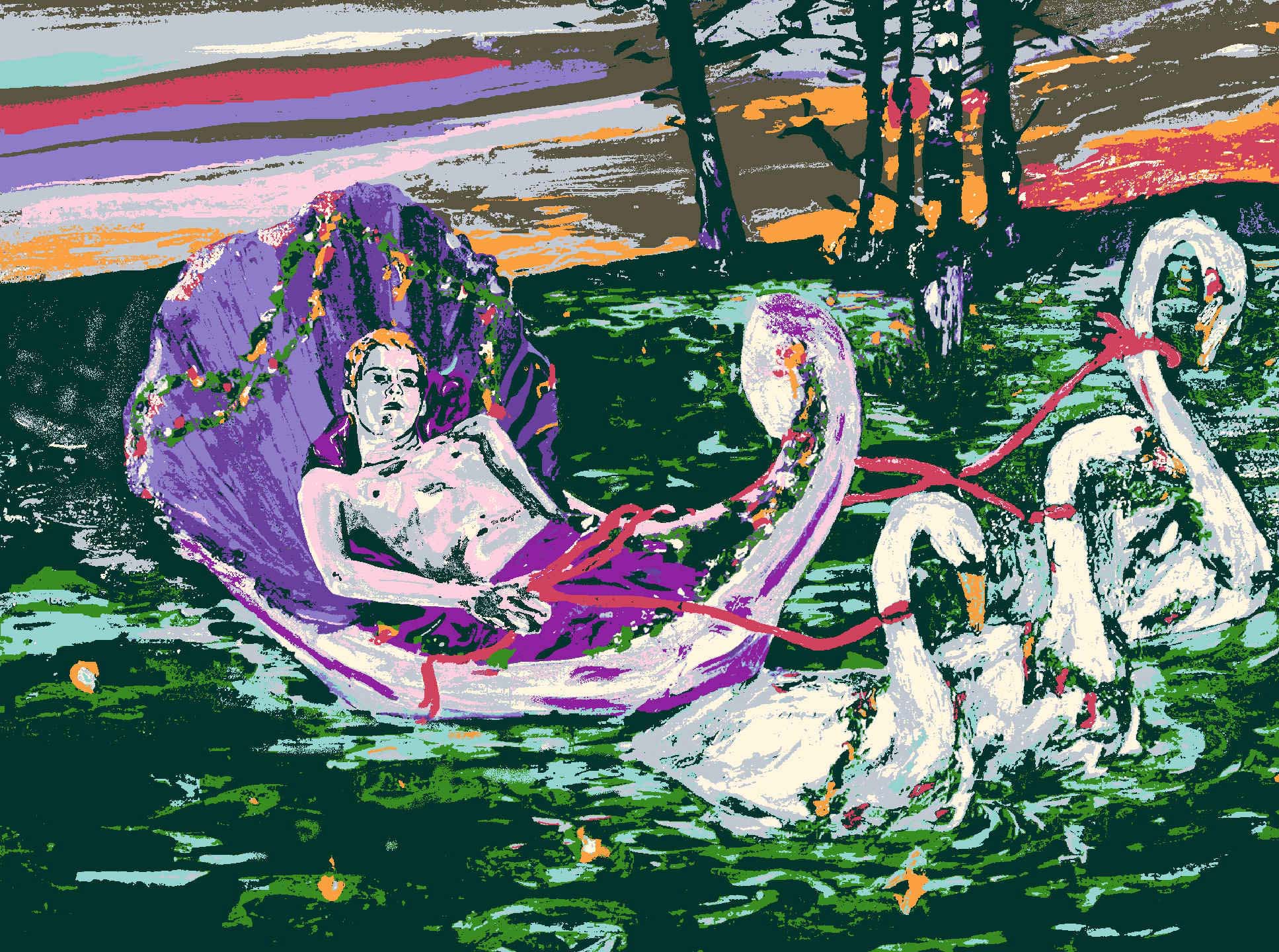
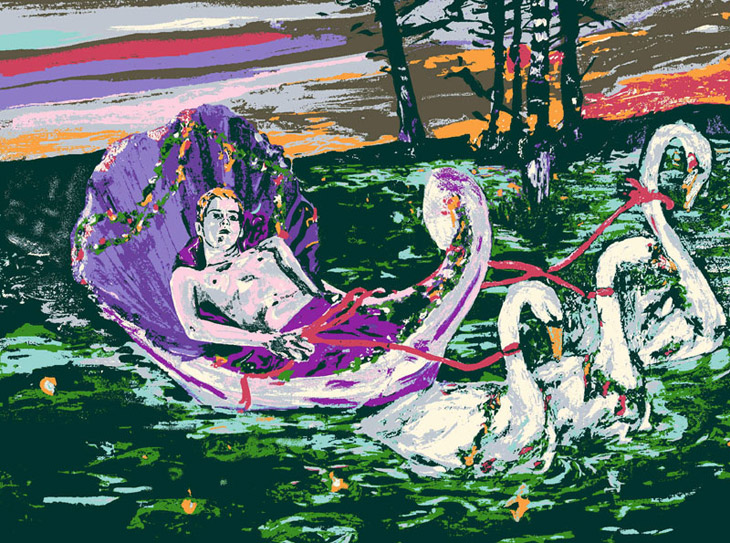
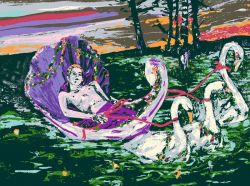
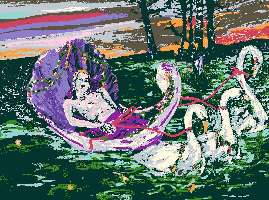
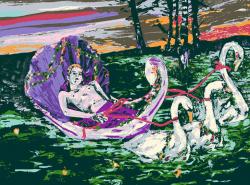
Hernan Bas' tapestry intricately weaves his subject of desire into an object of luxurious decadence. Drawing reference from the narrative regalia of medieval wall hangings, his carpet transfers the expressionist elegance of his paintings into stylised stitch work. Woven in bright colours, Bas’ mythological scene presents both a contemporary and timeless apotheosis. The acid hues and pixellated texture replicate the virtuality of television or digital imaging, while his antique process echoes the intimacy of heartfelt endeavour. In creating a functional object rather than a painterly illusion, Bas incorporates a more complex dimension to his opulent fantasies. His tapestry facilitates lifestyle embellishment and role-play fetishism.
Hernan Bas' tapestry intricately weaves his subject of desire into an object of luxurious decadence. Drawing reference from the narrative regalia of medieval wall hangings, his carpet transfers the expressionist elegance of his paintings to stylised stitch work. Woven in bright colours, Bas’ mythological scene presents both a contemporary and timeless apotheosis. The acid hues and pixellated texture replicate the virtuality of television or digital imaging, while his antique process echoes the intimacy of heartfelt endeavour. In creating a functional object rather than a painterly illusion, Bas incorporates a more complex dimension to his opulent fantasies. His tapestry facilitates lifestyle embellishment and role-play fetishism.
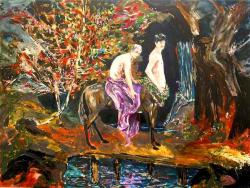
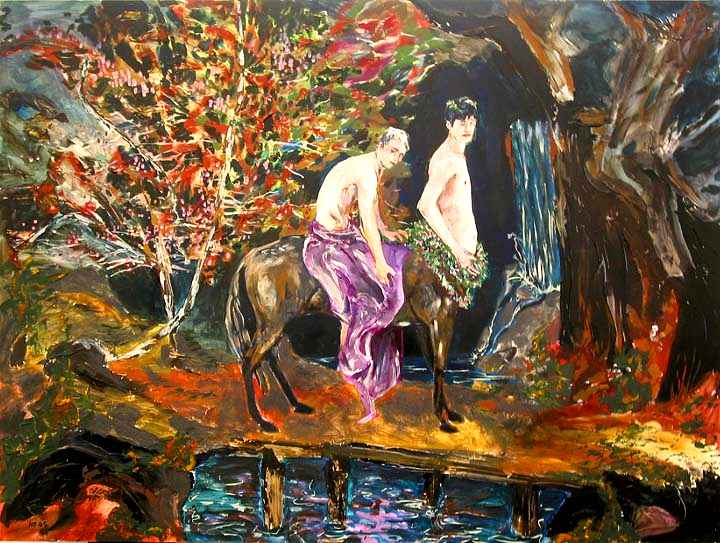
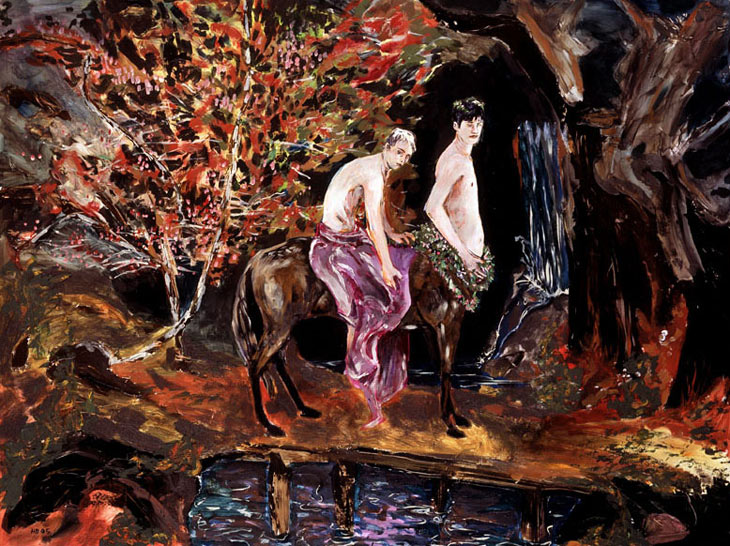
In
The Hero Centaur, Hernan Bas composes his painting
with acute sensitivity. His rich palette flames with dreamy
brushstrokes, forms swell and recede with controlled eroticism.
Mythology bridges the gap between children’s fantasy
and adult sophistication, adventure stories enmeshed in wanton
intrigue and violent plots. Bas situates his characters amidst
the turbulence of adolescence. Their sexuality has an aura
of naiveté, an awkward expedition into the enchanted
and unknown. Bas’ paintings are never explicit. Rather
his romanticised scenes exist as metaphors for emotional flux.
Wavering between virginal trepidation and gushy infatuation,
they capture precise moments of seasonal youth.
Heavily
influenced by The Decadence period of literature, Hernan Bas’s
paintings are inspired by well-worn pages of Wilde and Huysmans.
“Why does homosexuality seem to make you pre-disposed
to liking these things?” Bas questions. “As a
result this work is tainted with Saint Sebastian martyr types,
dying dandies and peacock feathers, all the materials that
dictate a certain queer vocabulary." Bas’ style
of painting emulates linguistic flourish. Impassioned brushwork
and pastel hues bloom with poetic description; environments
are set with the divine ambience of transience. Confined by
fanciful etiquette, Bas’ figures allude to darker sentiments.
Their posed innocence is but a thin veil of gentlemanly decorum.
Hernan
Bas’ paintings are tinged with a nihilist romanticism,
born of literary intrigue and a passion for historical painting.
Exploring the possibilities of dandyism in the modern world,
Bas’ bitter-sweet subject matter ranges from Greek mythology
to contemporary genre painting, always derived from his connoisseur’s
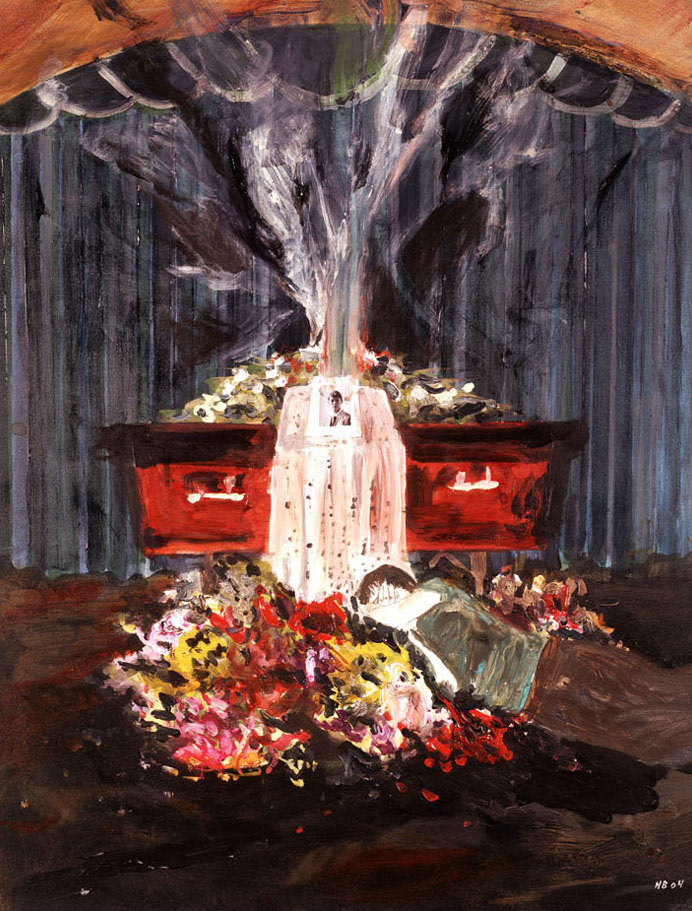
predilection for the poetic and empyreal. Funerals and cemeteries
appear often in Bas’s work, inspiring thoughts of Keats
gothic malaise and the tragedy of lost love condemned to an
eternally angelic slumber.
Passion
and violence are inextricably linked. In the pursuit of the
alchemy of dandyism, Bas embraces both the decadence and nastiness
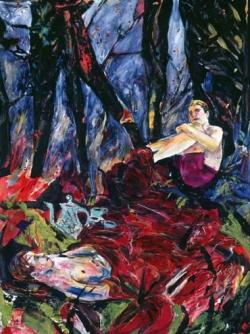
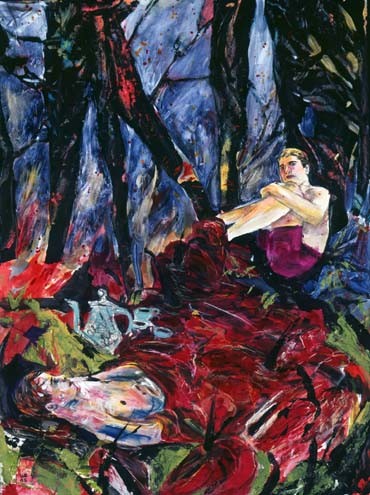
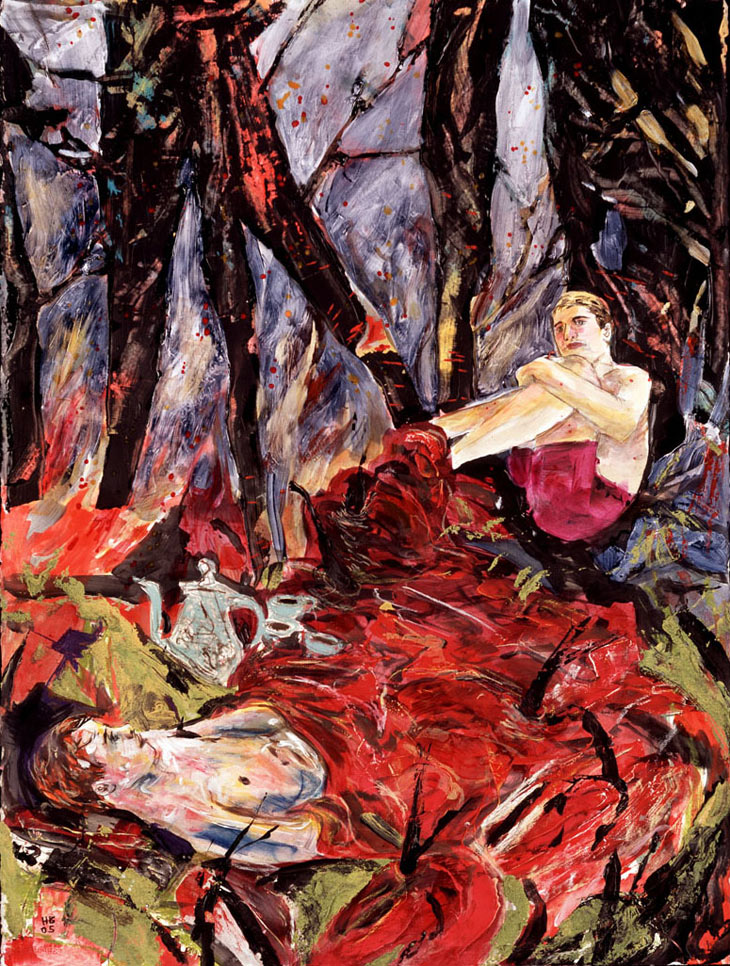
of pleasure. In
Burning Up For Your Love, Hernan
Bas imagines his young lovers’ forest rendez vous with
a look of aggression. Bas’ painting descends into a
maelstrom of expressive gestures: trees twist with charred
malice, encased by a necromantic mist. Bas styles the blanket
with carnal suggestion: its sinful red hue, replicated in
the splashes and splatters of leaves, suggest a more brutal
form of forbidden love. The natural physicality of one young
man is given an ethereal glow, presented as an almost god-like
form, while the other man lies darkened and bruised. The aftermath
of their indulgent tea party remains as litter.
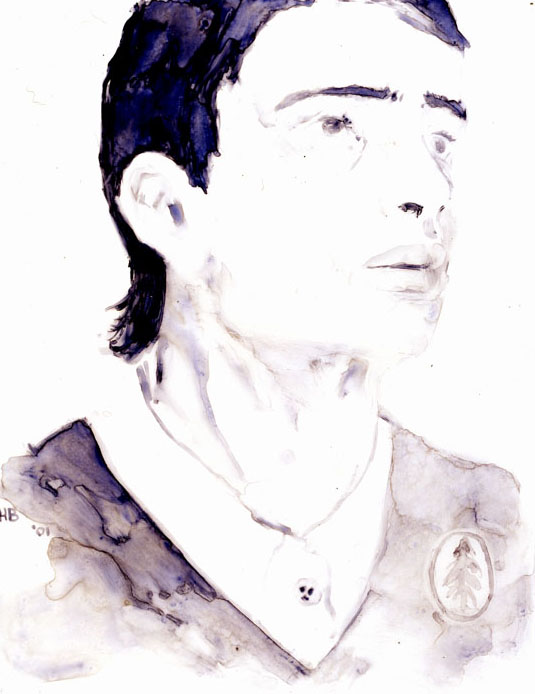
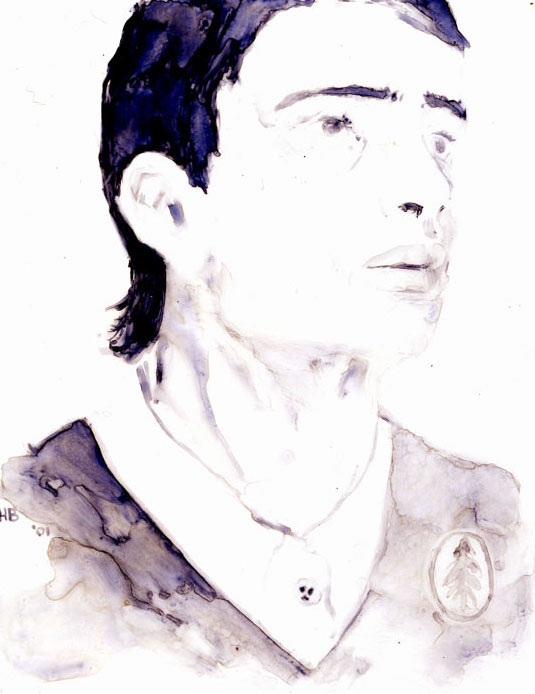
In
Untitled, Hernan Bas draws his boy scout as a
saint, paralleling a moment of pubescent realisation with
historical paintings of religious ecstasy. The use of black
paint on vellum gives this figure a timeless quality, reminiscent
of Old Masters cartoons. Here, Bas flaunts his skill as draughtsman:
his watery pigment bleeds in shadowy expression, yet retains
delicate precision of form. The whiteness of the paper suggests
spiritual illumination thus framing Bas’s muse in angelic
virtue.
Hernan
Bas’ paintings explore the codes of dandyism and its
subculture as a means to define sexual attraction. Bas’
paintings are small, frail, and sensuously delightful; through
their unassuming intimacy, they personify epic romance. Influence
by historical painting, Bas’ images contemporaneity,
their staginess, and immediate familiarity suggest the melodramatic
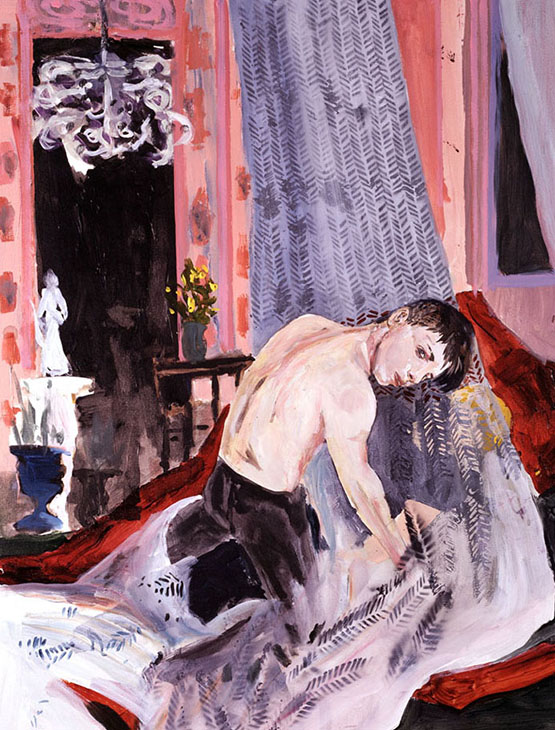
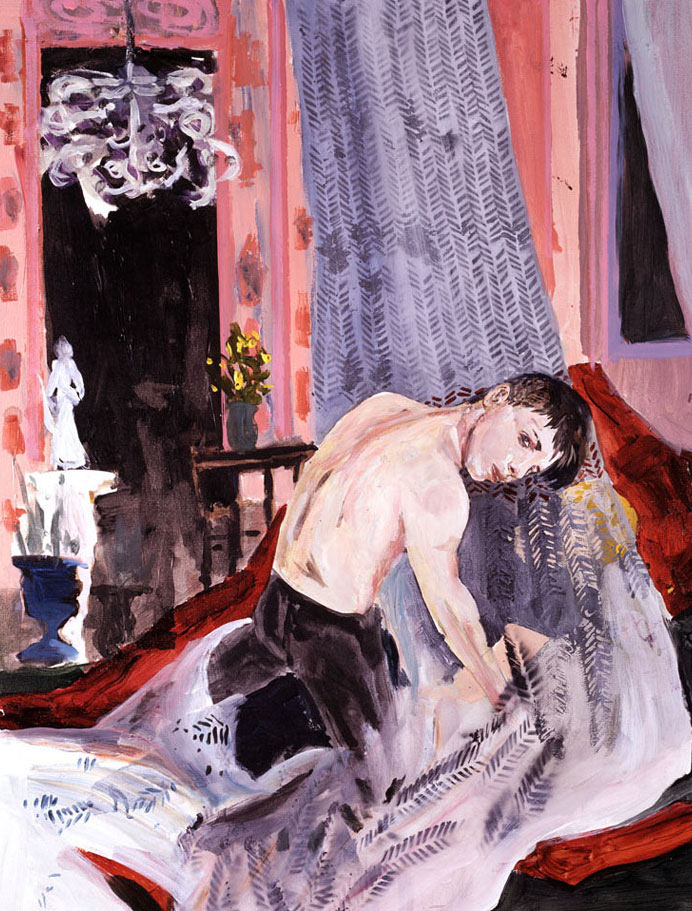
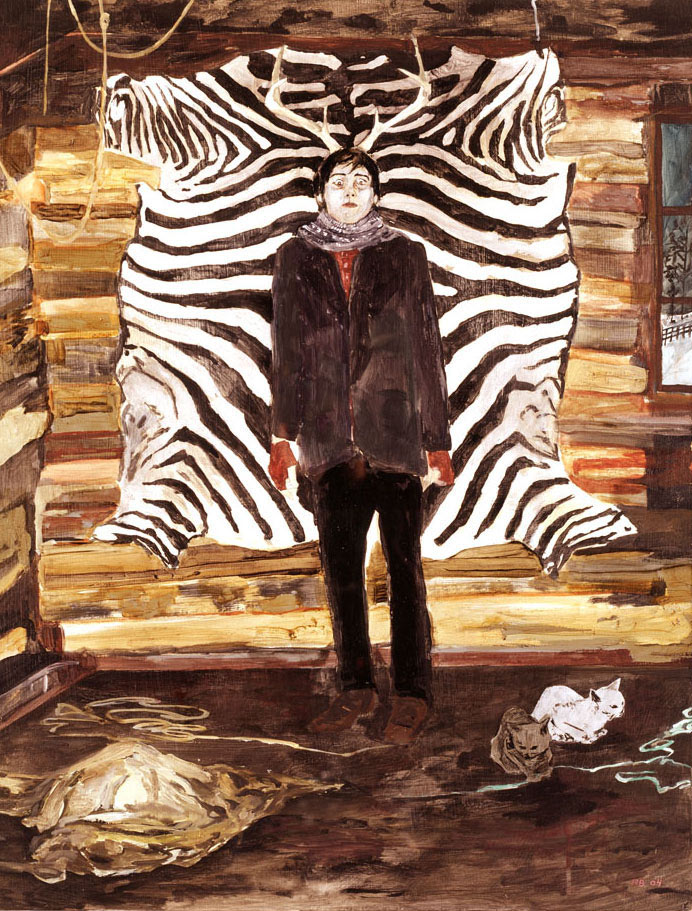
narratives of classic film. In
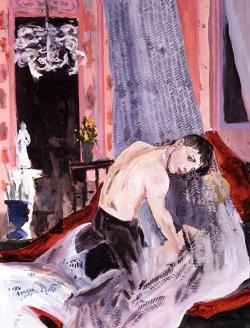
Posing with Antler,
Bas paints a waif-like boy, flirtatiously hamming it up for
snap shot laughs. Placing the viewer in the position of an
unseen photographer, Bas sets a scene of predatory seduction.

_ca.jpg)

_ca.jpg)